Back to Blog

From Data to Action: How We Build Your Personalized GEO Action Plan

Brightwill Team·2026-03-24

A score tells you where you stand. An action plan tells you what to do about it. After analyzing 100+ AI conversations across three engines, we have a detailed picture of where your business appears, where it doesn't, and why. The action plan turns that data into specific, prioritized steps.

This isn't generic advice like “improve your online presence.” Every action in your plan is tied to a real gap we found in your audit data - a source that cites your competitors but not you, a query type where you're consistently missing, or a technical issue blocking AI crawlers from your website.
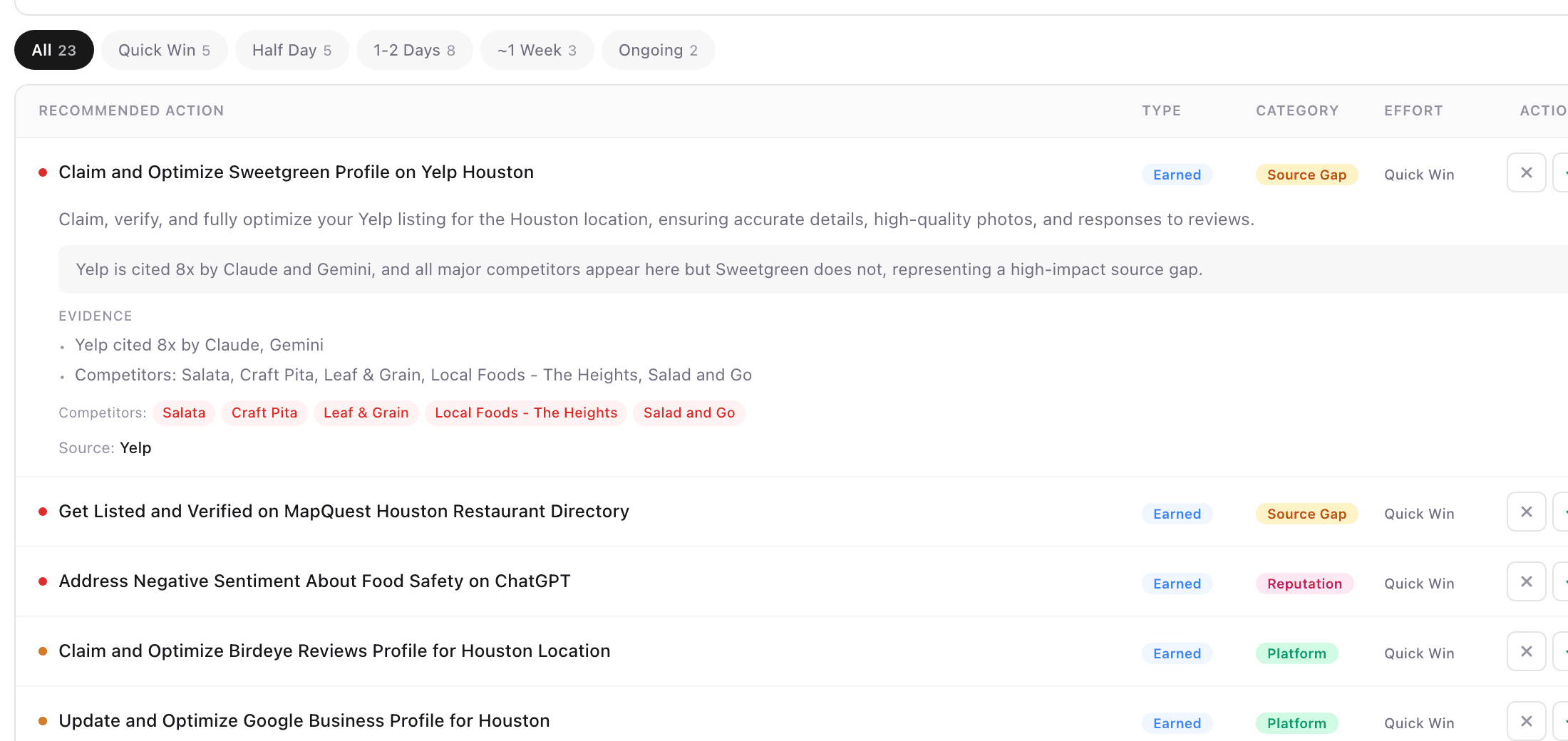
brightwill.ai/report
Brightwill action plan showing prioritized optimization actions
Every action is tied to real audit data - source gaps, competitor presence, and effort estimates help you prioritize.

Step 1: Pre-Computing Your Gaps

Before any recommendations are generated, we run a structured gap analysis across your audit data. This step is purely computational - no AI interpretation, just data processing. We compute five types of gaps:

Source Gaps
Sources that AI engines cite when recommending competitors in your space, but that don't appear when discussing your business. Each gap includes the source name, how many times it was cited across your audit, and which competitors benefit from it.
Yelp cited 12 times in your audit - competitors appear, you don't
Content Gaps
Query types where your miss rate is high. If AI mentions you on direct queries but never on discovery queries, that's a content gap - you're known by name but not being organically recommended.
72% miss rate on use_case queries (0 of 7 triggered a mention)
Competitor Presence
Which competitors appear more frequently, rank higher, and show up on more platforms than you. Source-grounded: each competitor's platform presence is traced to the specific sources the AI cited (e.g., 'Yelp', 'Google Reviews'), not estimated.
Competitor X mentioned 28 times, found via Yelp and Google Reviews
Sentiment Issues
Negative sentiment phrases extracted from AI responses about your business, tagged by which AI engine said them and which source platform the sentiment originated from.
Claude: "some customers have reported slow service" (via Yelp)
Technical Issues
Problems found in the website scan - blocked AI crawlers, missing Schema.org markup, restrictive meta directives. These prevent AI from accessing and understanding your website content.
GPTBot and ClaudeBot blocked by robots.txt

These gaps are computed directly from the structured data extracted during the response analysis phase. Source gaps come from the citation tracking. Content gaps come from per-query-type mention rates. Competitor presence comes from the competitor extraction with source attribution- each competitor's platform presence is traced to the specific source the AI cited, not estimated. Nothing is guessed - every gap is backed by specific query-response pairs.

Source-grounded competitor data: When we report that a competitor “appears on Yelp and TripAdvisor,” that's because the AI explicitly cited those platforms when mentioning that competitor. Previous versions used a heuristic that assumed all competitors appeared on all cited sources - source attribution eliminates this inaccuracy and ensures your action plan targets the right platforms.

Step 2: Structuring the Data

The pre-computed gaps are formatted into a structured document with five sections: SOURCE GAPS, CONTENT GAPS, TOP COMPETITORS, NEGATIVE SENTIMENT ISSUES, and TECHNICAL ISSUES. Each section includes the actual numbers - citation counts, miss rates, competitor names, specific phrases.

This structured document is what the action plan generator receives. By pre-computing and formatting the gaps before generation, we ensure that every recommended action can point to specific data. The generator doesn't have to search through raw audit data - it receives a clean summary of exactly what's wrong and where the opportunities are.

Step 3: Generating Specific Actions

GPT-4.1 receives the gap analysis, your business context (category, location, scope), and the detection scan results (if available). It generates 15 to 30 specific actions, each required to reference the actual data from the gaps.

Anatomy of an Action

Title
A specific, actionable headline (e.g. "Claim and optimize your Yelp business page")
Description
1-2 sentences explaining what to do and why it matters for AI visibility
Reasoning
The data-driven rationale - which gap this addresses, with specific numbers
Action Type
One of 6 types: source gap, content gap, technical, reputation, platform presence, or knowledge gap
Media Type
Earned (third-party platforms) or Owned (your website and content)
Opportunity Level
High, medium, or low - based on source citation frequency and competitor gap size
Priority
Critical, high, medium, or low - how urgently this should be addressed
Effort
Quick win, half day, 1-2 days, 1 week, or ongoing
Data Points
1-3 specific citations from audit data backing this recommendation
Source Name
The specific source to target (e.g. "Yelp", "Reddit", "Google Business Profile")
Competitor Names
Which competitors benefit from the gap this action addresses

The output is validated against a strict schema. Actions that don't include reasoning or data points are rejected. This is how we ensure the plan is data-driven rather than generic.

The Earned vs Owned Framework

Every action is classified as either Earned Media (things you influence on third-party platforms) or Owned Media (things you control on your own website and content). This split helps you prioritize based on what kind of work you're equipped to do.

Earned Media
Actions on platforms you don't own - review sites, directories, social media, news coverage. These shape what sources AI cites about you.
Source Gap: Get listed on sources that cite your competitors
Platform Presence: Claim and optimize profiles on key directories
Reputation: Address negative reviews or sentiment issues
Owned Media
Actions on your own website and content. These control what AI can learn directly from your digital properties.
Content Gap: Create content targeting query types where you're missing
Technical: Fix website issues blocking AI access (crawlers, schema)
Knowledge Gap: Publish content about topics competitors rank for
Quick wins first. Sort your action plan by effort (quick wins) and opportunity (high). The highest-impact, lowest-effort actions are where you should start - many businesses see measurable visibility improvements within weeks by focusing on these.

Opportunity Scoring

Not all gaps are equal. A source cited 15 times across your audit where three competitors appear and you don't is a bigger opportunity than a source cited twice. The opportunity score ranks actions by potential impact.

High Opportunity
Large gap with high citation frequency. Sources cited 12+ times, multiple competitors present, you absent. These represent the biggest potential visibility gains.
Medium Opportunity
Moderate gap or moderate citation frequency. The source matters to AI, and closing this gap will improve your position, but the impact is more incremental.
Low Opportunity
Smaller gaps or less influential sources. Worth doing for completeness, but not where you should focus first.

Each action also includes an effort estimate: quick win (under an hour), half day, 1–2 days, 1 week, or ongoing. Combined with the opportunity level, this helps you find the high-impact, low-effort actions first - the classic quick wins that move the needle fastest.

Triage: Making It Actionable

A 25-item action plan can feel overwhelming. That's why every action in your plan has a triage status: Todo, Skip, or Done. You can quickly mark items as skipped if they don't apply to your situation, and track completion as you work through the plan.

The plan is also regenerable. If you've completed several actions and want a fresh set of recommendations, you can regenerate the plan to get updated priorities based on the same audit data.

Data In, Actions Out

The action plan is the final step in the chain: we generate targeted queries, run them against real AI engines, extract structured data from every response, compute gaps, and generate specific actions tied to real data. Combined with the technical readiness scan, every recommendation in your plan has a traceable path back to something an AI engine actually said (or didn't say) about your business.

Run a free audit to see your ChatGPT recommendation probability, then upgrade to the full audit for the complete action plan with 15–30 prioritized steps.

Continue Reading

Methodology8 min read

How We Analyze Every AI Response: Our Multi-Layer Extraction Pipeline

How we turn raw AI conversations into structured data — extracting mentions, sentiment, competitor rankings, and source citations from every response.

Read more
Methodology7 min read

Can AI Find Your Website? Inside Our Technical Readiness Scan

What our technical AI readiness scan checks, how the scoring works, and what each grade means for your website's ability to be found by AI engines.

Read more
Methodology10 min read

Inside Our Query Engine: How We Test 100+ AI Conversations About Your Business

How we generate and test 100+ tailored AI conversations per audit — from business profiling to 10 query types across 16 business categories.

Read more