Your audience isn't just using Google anymore. They're asking ChatGPT for product recommendations, using Gemini for research, and getting answers from Claude. People are having conversations with AI instead of searching with keywords - and that means visibility works differently now. The discipline of making sure your brand shows up in those conversations is called Generative Engine Optimization, or GEO for short. This guide breaks down exactly what GEO is, why it matters, and what you can do about it today.
What Is Generative Engine Optimization (GEO)?
Generative Engine Optimization is the practice of improving how your business appears in AI-generated answers. When someone asks ChatGPT “best Italian restaurant near downtown” or asks Claude “recommend a CRM for small teams,” the AI assembles a response by pulling from training data, live web searches, business directories, review platforms, and structured data it finds on your site. GEO is the set of strategies that influence which businesses the AI decides to surface.
Traditional SEO optimizes for Google’s ranking algorithm. GEO optimizes for the language models behind ChatGPT, Claude, and Gemini. The two disciplines overlap - strong SEO still helps - but they are not the same thing. AI engines weigh signals differently, and they do not display a list of links. They recommend a handful of businesses by name and explain why.
Why GEO Matters Right Now
The shift toward AI-powered search is happening faster than most business owners realize. ChatGPT surpassed 200 million weekly active users in 2024, and that number continues to climb. Google has rolled generative AI Overviews into its core search product, meaning even traditional Google searches now feature AI-written summaries above the organic results. Meanwhile, Claude and Gemini are rapidly gaining adoption among professionals who rely on AI for vendor research, service recommendations, and purchase decisions.
Here is what that means in practice:
- Zero-click answers are the new normal. When ChatGPT tells a user exactly which plumber to call, that user rarely goes to Google afterward. The AI’s recommendation is the decision.
- AI recommendations carry outsized trust. People trust AI-generated suggestions differently than search results. When ChatGPT names your business specifically, it reads as a personal recommendation, not an ad.
- Your competitors are already showing up. AI engines recommend someone in your category. If it is not you, it is a competitor. Every day you are invisible to AI search is a day your competitors capture that demand.
How AI Engines Choose What to Recommend
So what actually moves the needle? AI models do not have a single ranking algorithm the way Google does. Instead, they synthesize information from multiple sources to build a picture of which businesses are relevant, reputable, and worth recommending. The main signals include:
Reviews and Reputation
AI models heavily reference review platforms like Google Business Profile, Yelp, Trustpilot, and G2. A business with hundreds of positive, detailed reviews is far more likely to be recommended than one with a handful of generic ratings. The content of reviews matters just as much as the star rating - AI models parse review text for specific services, quality signals, and customer outcomes.
Citations in Authoritative Content
When your business is mentioned in news articles, industry roundups, “best of” lists, or expert blog posts, AI models treat those citations as trust signals. This is similar to how backlinks work in SEO, but with an important distinction: AI models care more about the context of the mention than the domain authority of the site. Being recommended by name in a well-written guide carries significant weight. For a deeper look at this process, see our guide on how AI recommends businesses.
Structured Data and Schema Markup
JSON-LD structured data on your website helps AI models understand exactly what your business does, where it is located, what services it offers, and what customers say about it. Schema types like LocalBusiness, Product, FAQPage, and Review give AI engines machine-readable facts they can use directly in responses.
Directory and Aggregator Presence
AI models with web search capabilities pull real-time data from business directories, aggregators, and listing sites. Consistent, complete profiles across platforms like Google Business Profile, Yelp, Apple Maps, Bing Places, and industry-specific directories strengthen your digital footprint and increase the likelihood of AI mentions.
GEO vs. SEO: What Is Different?
GEO and SEO share common ground - both reward quality content, strong backlink profiles, and accurate business information. But there are meaningful differences in how signals are weighted and how results are delivered.
- Output format: SEO produces a list of ranked links. GEO produces a written recommendation where only a few businesses are named.
- Winner-take-most dynamics: In traditional search, the top 10 results all get clicks. In AI answers, the 2-3 businesses named get virtually all the attention.
- Signal weighting: AI models place more emphasis on review sentiment, citation context, and structured data than traditional ranking factors like keyword density or page speed.
- Multi-model landscape: SEO targets one search engine at a time. GEO must account for ChatGPT, Claude, and Gemini, each of which has different training data and different search capabilities.
We cover this topic in depth in our GEO vs. SEO comparison guide.
What Drives AI Recommendations
Five signals consistently determine whether an AI engine recommends a business: review volume and recency, third-party citations (mentions in articles, guides, and directories), structured data on your website (JSON-LD schema markup), NAP consistency (name, address, phone matching across every platform), and content depth that demonstrates real expertise in your category.
We wrote a full step-by-step breakdown of each signal and how to act on it in our guide to getting your business recommended by ChatGPT. If you want to understand how each AI engine weighs these signals differently, read how ChatGPT, Claude, and Gemini choose which businesses to recommend.
How to Audit Your AI Visibility
The first step in any GEO strategy is understanding where you stand today. You need to know whether AI engines are recommending your business, how often, and with what sentiment. Without baseline data, you are optimizing blind.
An AI visibility audit involves querying multiple AI platforms with the kinds of questions your potential customers ask. For a restaurant, that might be “best Thai food in Austin” or “where should I eat near downtown.” For a SaaS product, it could be “best project management tool for remote teams.” You then analyze whether and how each AI responds with your business.
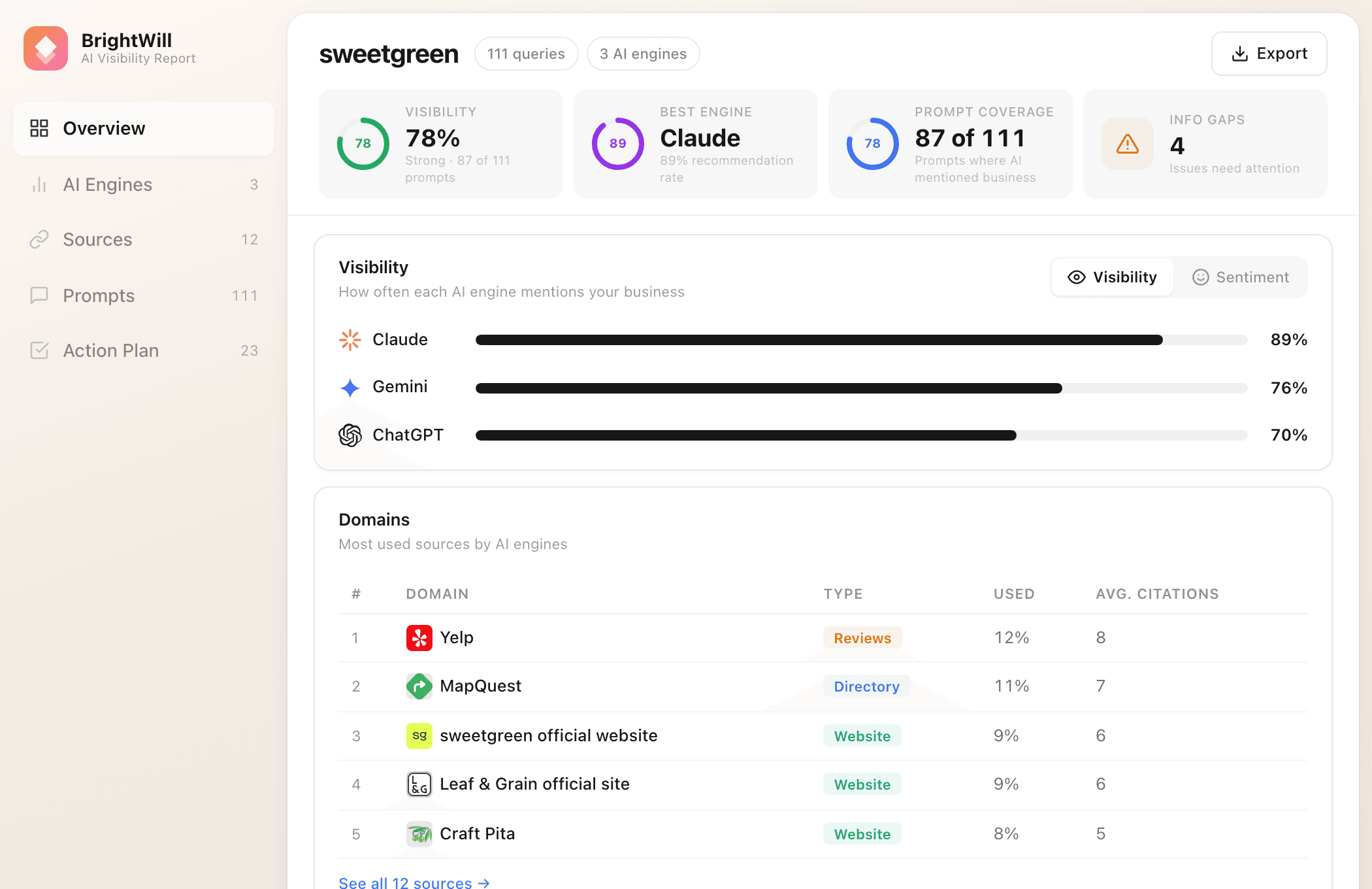
Doing this manually is time-consuming, which is why we built Brightwill’s free AI Visibility Score audit. It shows you how your brand appears in AI search - your visibility, position, and sentiment across ChatGPT, Claude, and Gemini. You'll see which sources shape your rankings, who your competitors are in AI conversations, and get actionable recommendations to improve.
Getting Started with GEO
GEO is already here. As AI-powered search becomes the primary way people discover businesses, products, and services, the businesses that optimize for AI visibility early will have a head start. The fundamentals are straightforward: build a strong review profile, earn citations in authoritative content, implement structured data, maintain consistent business information, and create content that demonstrates your expertise.
The best place to start is with a clear understanding of where you stand. Run a free AI Visibility Score audit to see exactly how your brand appears across AI search today. From there, you can build a targeted GEO strategy based on real data rather than guesswork.