When ChatGPT responds to “What's the best sushi restaurant in Miami?”, it produces a paragraph (or several) of natural language text. That text might mention your business, recommend a competitor, cite a review source, or say nothing useful at all. To turn that raw text into quantifiable data, every response goes through a structured extraction pipeline.
This article explains exactly what we extract from each AI response, how we measure mention quality on a continuous scale, and why we use a separate AI model for parsing rather than having the queried engine evaluate itself.
The Parsing Pipeline
Each of the 100+ responses in a comprehensive audit is parsed independently by GPT-4.1-mini. We chose this model specifically for extraction because it runs at temperature 0 (fully deterministic) in JSON mode, producing structured output that we validate against a strict schema.
The parser receives two inputs: the raw AI response text and your business name. It doesn't see other responses, previous results, or any context that might bias its extraction. Each response is evaluated in isolation.
What We Extract From Every Response
The parser extracts 11 structured fields from each response. Together, these fields capture not just whether you were mentioned, but exactly how you were characterized, where you ranked, and what sources influenced the response.
Mention Strength: A Continuous Signal
The mention type field (primary/passing/not mentioned) is useful but coarse. A business that gets a dedicated paragraph of praise is fundamentally different from one that appears as the seventh name in a list - even though both count as “mentioned.” The mention strength score (0.0 to 1.0) captures this nuance.
Mention strength feeds directly into the “Mention Quality” component of your AI Visibility Score, which accounts for 15% of your total score. A business that's mentioned in every response but only as a passing reference will score lower than one that's featured prominently in fewer responses.
Source Citation Tracking
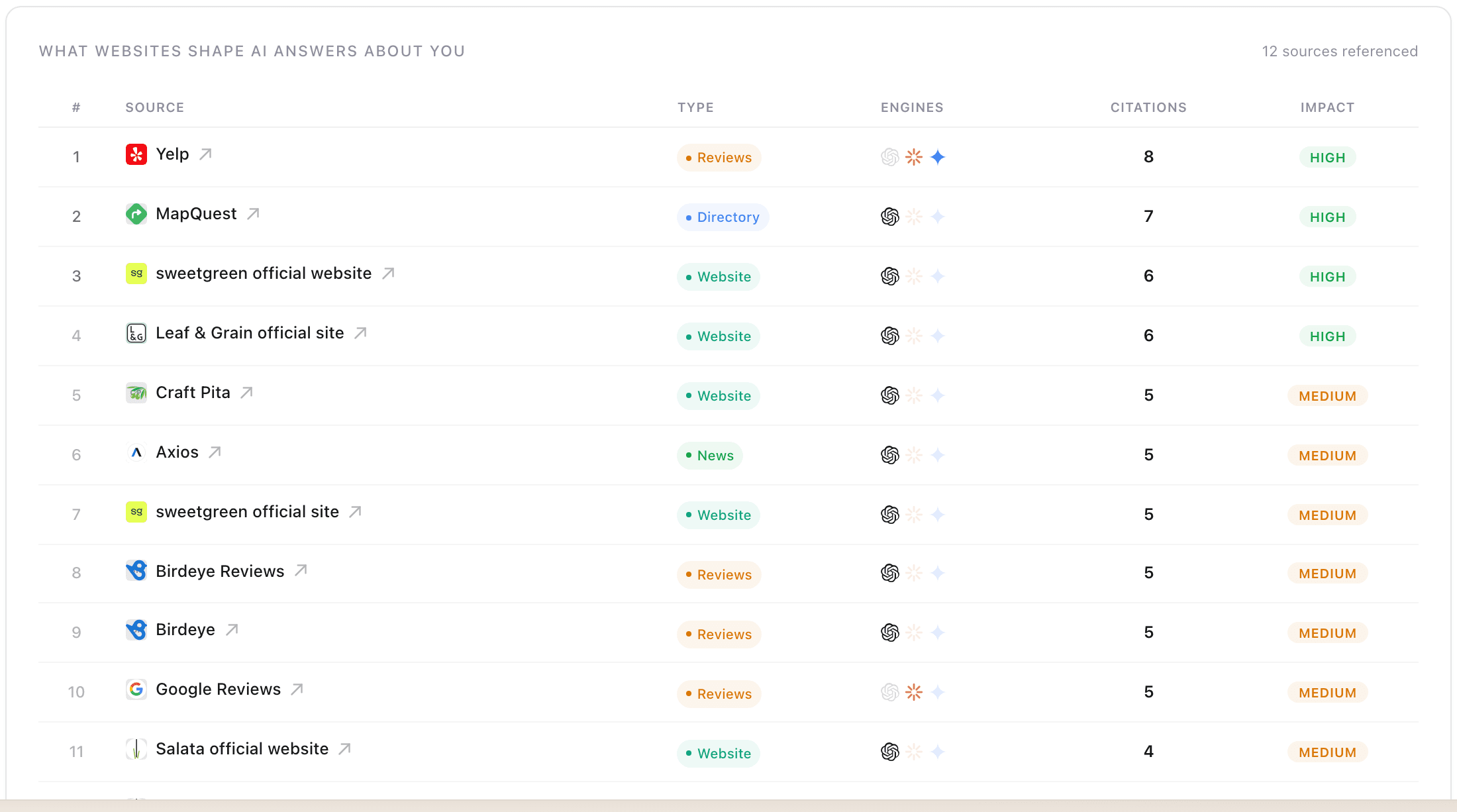
One of the most actionable things we extract is which sources AI engines cite when making recommendations. When ChatGPT says “According to Yelp reviews...” or “Based on their Google Business Profile...”, that tells you which information sources are shaping your AI visibility.
We classify sources into six types:
These citations are aggregated across all queries and all providers to produce the Source Influence analysis in your report. If Yelp is cited 15 times across your audit but your Yelp profile is thin, that's a clear optimization opportunity. If your website is never cited, it may mean AI crawlers can't access your content.
Source Attribution: Tracing Every Data Point
Beyond tracking which sources an AI response cites, we now trace individual data points back to their source. When the parser extracts a fact, a competitor mention, a sentiment phrase, or a topic association, it also extracts which platform or site the AI attributed that information to.
hours: “11am-10pm” → via Google Maps
sentiment: “praise their omakase” → via Yelp
This source attribution flows through the entire pipeline. In your report, the “What AI Knows About You” card shows not just what each engine said, but where it got the information:
Claude Not mentioned
Gemini (910) 791-0280 via Yelp
Source attribution also improves the action plan. Instead of guessing which platforms your competitors appear on, the system uses real data - if the AI cited a competitor “via TripAdvisor,” that competitor's TripAdvisor presence is a confirmed fact, not a heuristic assumption.
From Individual Responses to Your Score
The extracted data from all responses is aggregated into your GEO Score (0-100), a weighted composite of seven factors:
The Technical AI Readiness component (20%) comes from the website scan. If no website URL is provided, that 20% is redistributed proportionally across the other six components. For the full breakdown of how the score works, see AI Visibility Score explained.
Why We Use a Separate Parser
A natural question: why not ask ChatGPT to evaluate its own responses? The answer is objectivity. The AI that generates the recommendation is not the same AI that analyzes it.
We query three different AI engines (ChatGPT, Claude, Gemini) with real questions, collecting their natural responses. Then a separate model (GPT-4.1-mini, optimized for extraction) parses every response using the same consistent criteria. This avoids self-evaluation bias - a model might be generous in assessing its own outputs. By keeping generation and evaluation separate, we get a more honest picture.
The parser also runs at temperature 0, meaning the same response text always produces the same extracted data. There's no randomness in the analysis step. If you ran the same audit twice with the same AI responses, you'd get identical structured data.
See It in Action
Every data point in your Brightwill report traces back to a real AI conversation that went through this extraction pipeline. The sentiment phrases, competitor names, source citations, and mention types in your report are all extracted directly from what the AI actually said - not estimated or inferred.
Run a free audit to see how ChatGPT responds to 5 real queries about your business. To see how the extracted data becomes a prioritized optimization plan, read how we build your action plan.