Every day, millions of people are having conversations with AI instead of searching with keywords. They ask ChatGPT, Claude, and Gemini questions like “What's the best Italian restaurant near me?” or “Which CRM should I use for a small team?” These AI engines respond with direct recommendations, naming specific businesses. The ones they mention get a powerful new source of customers.
But here's the problem: most businesses have no idea whether AI is recommending them or not. There's no equivalent of checking your Google ranking. You can't just search and see where you appear. That's why we built the AI Visibility Score, a systematic way to measure how likely AI engines are to recommend your business when customers ask relevant questions.
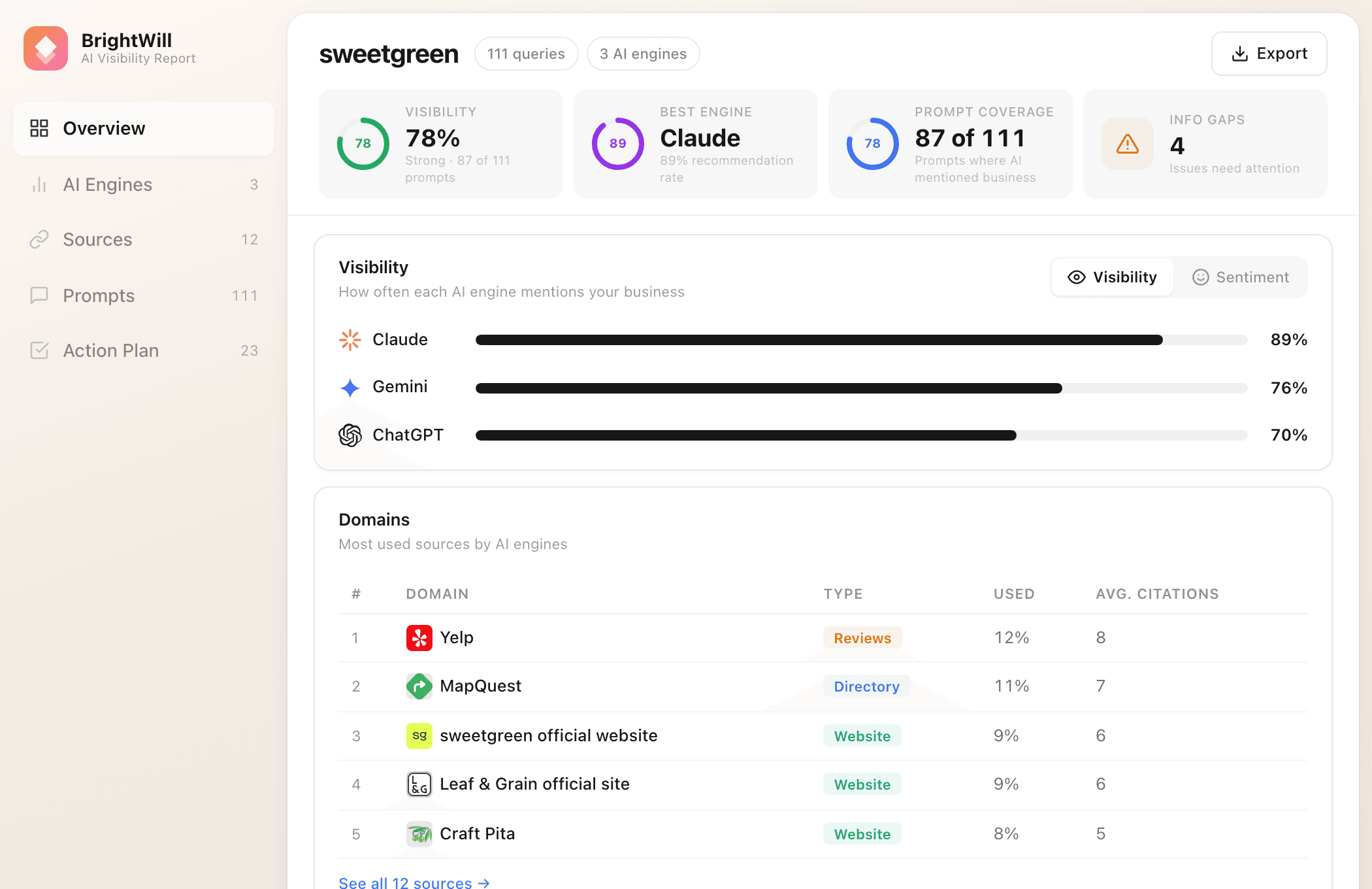
What Is an AI Visibility Score?
An AI Visibility Score is a number from 0 to 100 that represents how likely AI engines are to recommend your business when someone asks a relevant question. A score of 0 means AI never mentions your business. A score of 100 means AI consistently recommends you as the top choice across every relevant query.
Think of it as the AI equivalent of your Google search ranking, but instead of measuring position on a results page, it measures the probability that an AI engine will name your business in a conversational response. This matters because AI recommendations carry significant weight with users. When ChatGPT tells someone your business is the best option, that carries an implicit endorsement that a search result link doesn't.
The score isn't based on a single query. It's an aggregate measurement across dozens or hundreds of real queries that your potential customers might ask, tested across multiple AI platforms, analyzed for not just whether you're mentioned but how you're mentioned.
Why Measuring AI Visibility Matters
AI search adoption is accelerating rapidly. ChatGPT has over 200 million weekly active users, and Google's own AI Overviews now appear in a growing share of search results. For many users, asking an AI has become the default way to find businesses, products, and services.
Without measurement, you have no baseline. You might be investing in marketing, content, and reviews without knowing whether AI engines are picking up on those signals. Worse, your competitors might already be showing up in AI recommendations while you're invisible. An AI visibility audit gives you the data to make informed decisions about where to invest your optimization efforts.
It also establishes a baseline. Once you know your current score, you can track improvements over time and measure the ROI of specific optimizations, whether that's adding structured data, building review volume, or creating AI-friendly content.
How We Measure AI Visibility: Our Methodology
Our AI Visibility Score isn't a guess or an estimate. It's based on a rigorous methodology that queries real AI engines with real questions and analyzes the actual responses. Here's how it works, step by step.
Step 1: Query Generation
We start by generating a comprehensive set of queries that your potential customers would actually ask AI engines. These aren't generic questions. They're tailored to your specific business category, location, and specialties.
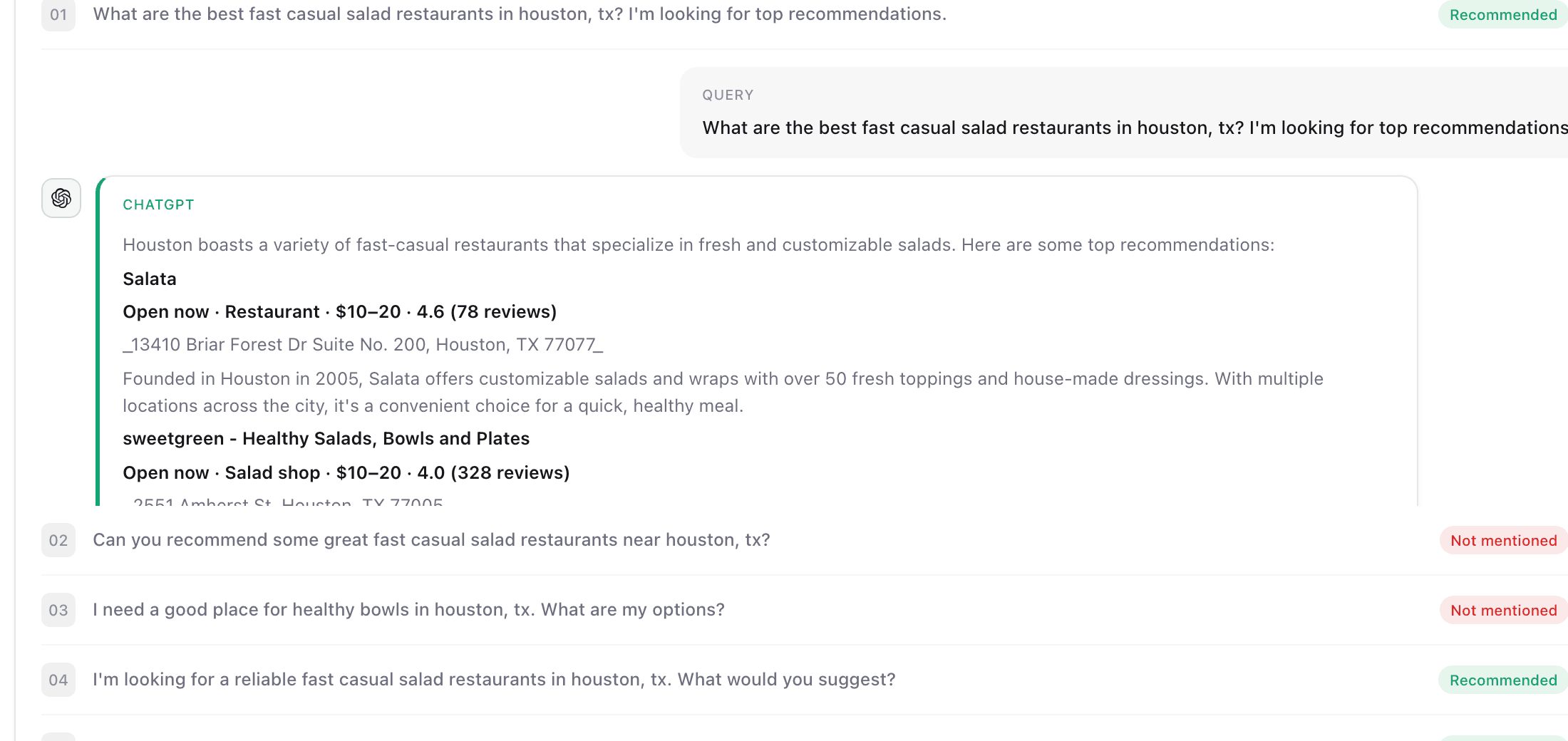
For a comprehensive audit, we test over 100 queries across three major AI engines: ChatGPT, Claude, and Gemini. The queries span ten distinct types:
Roughly 60% of queries are organic (they don't mention your business name), which tests organic discovery — whether AI recommends you when someone is looking for what you offer but hasn't heard of you. The remaining queries mention your business directly, testing brand awareness, reputation accuracy, and factual knowledge.
Important methodology note: Your AI Visibility Score and recommendation probability are calculated using only organic queries (discovery, use case, comparison, and subcategory searches). Direct queries, reviews, fact verification, and other brand-aware query types are excluded from the probability calculation because they would inflate the score — of course AI mentions you when you ask about yourself by name. The organic-only approach gives you an honest measure of how likely AI is to recommend you to someone who doesn't already know your name.
Step 2: Response Analysis
Every AI response is analyzed through a structured extraction pipeline. For each query, we determine:
Step 3: Score Calculation
The AI Visibility Score (0-100) is a weighted composite of seven factors, each capturing a different dimension of how well your business performs in AI recommendations:
We split the recommendation probability into two sub-metrics: the Organic Discovery Rate (how often AI recommends you on generic, non-branded queries) and the Brand Awareness Rate (how accurately AI responds when someone asks about you by name). Both are important, but organic discovery is where the real growth opportunity lies.
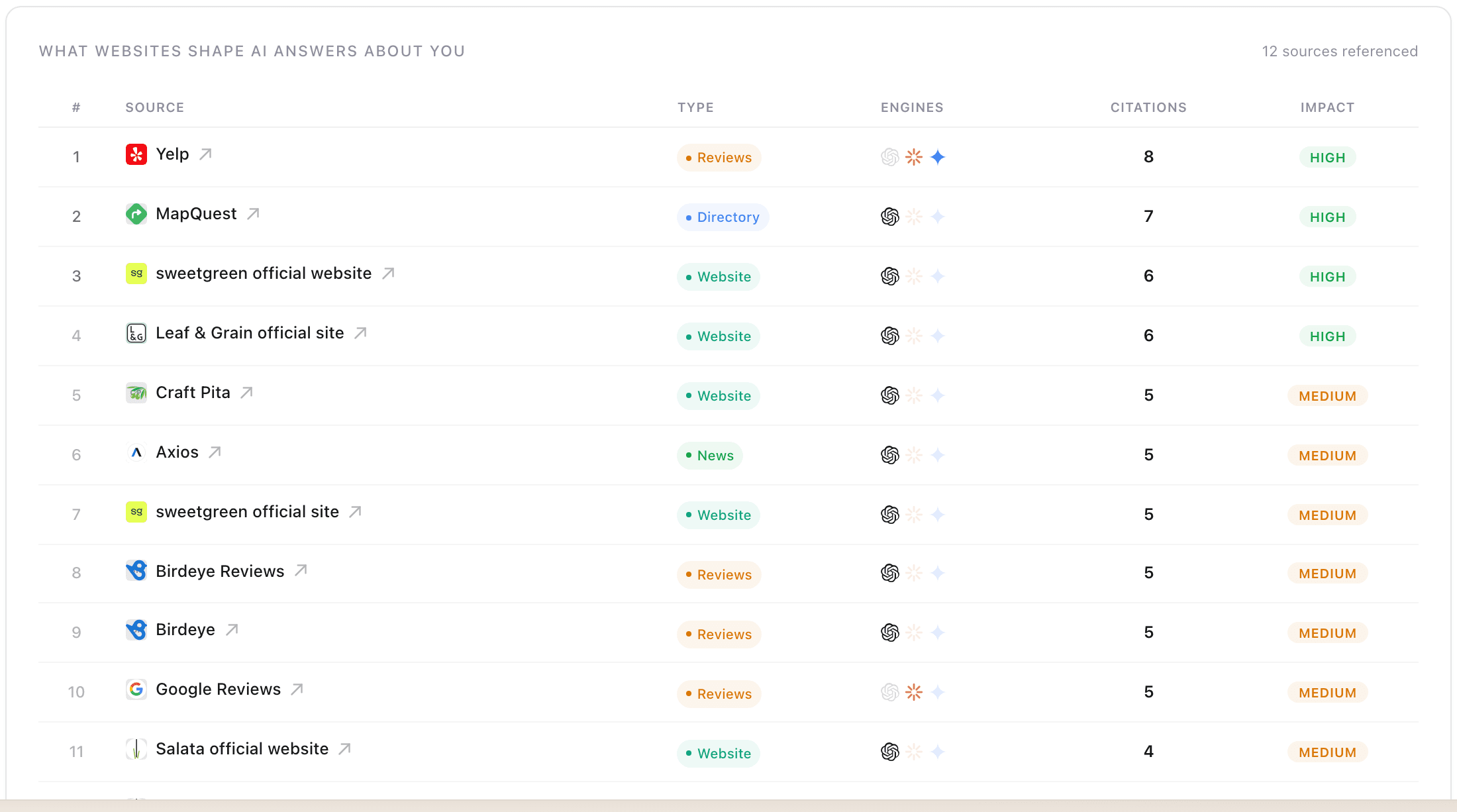
Step 4: Source Influence Analysis
Beyond the score itself, we analyze which sources AI engines cite when recommending (or not recommending) your business. This reveals the information ecosystem that shapes your AI presence. Common influential sources include Google Business Profile, Yelp, industry directories, news coverage, your own website, and social media profiles.
Understanding source influence is actionable. If AI engines are citing Yelp reviews when recommending your competitors but not you, the fix is clear: strengthen your Yelp presence. If your website is never cited, it may mean AI crawlers can't access your content, or your content lacks the structured data that makes it easy for AI to extract facts.
What Makes a Good Score?
AI Visibility Scores follow a 0-100 scale. Here's how to interpret where you fall:
Most businesses we audit score between 15 and 45 on their first test. This isn't surprising. AI visibility is a new channel, and most businesses haven't optimized for it at all. The gap between where most businesses are and where they could be represents a significant opportunity.
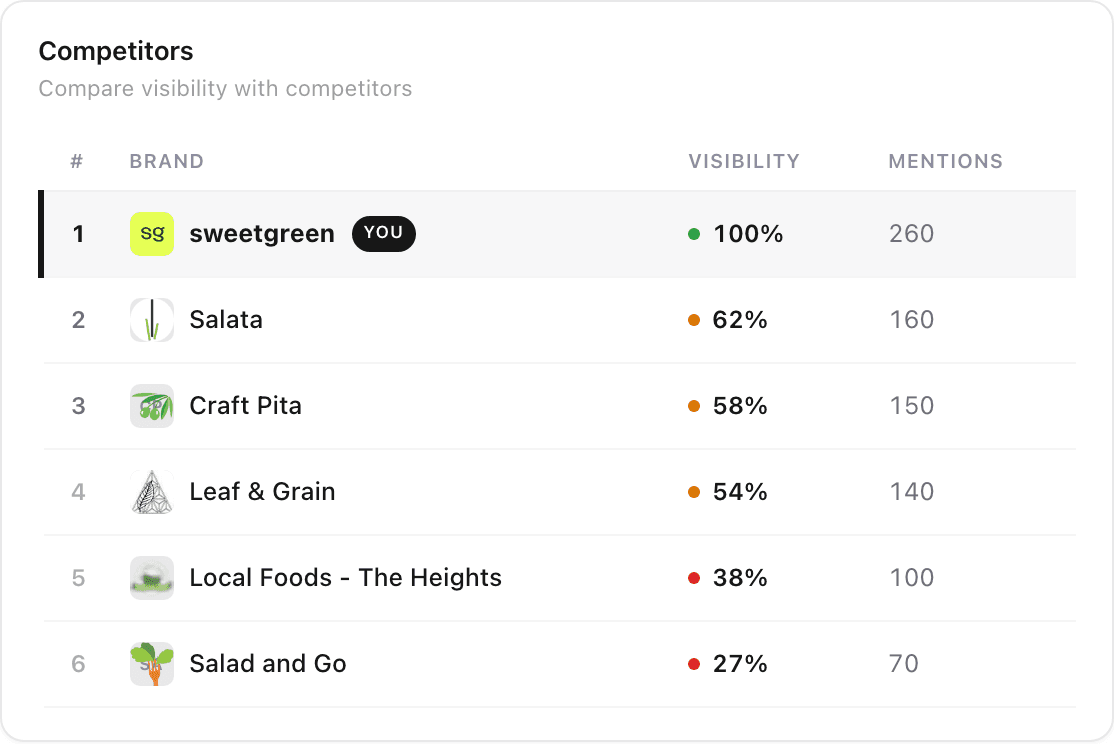
Free Audit vs Full Audit
We offer two levels of AI visibility measurement, designed for different stages of your optimization journey:
The free audit is the fastest way to get a directional read on your AI visibility. It answers the most fundamental question: is ChatGPT recommending your business right now? The full audit provides the depth needed to build an actual optimization strategy, with cross-platform analysis, source influence data, and a prioritized action plan.
How to Interpret and Improve Your Score
Your score is not a vanity metric - it maps directly to how often AI engines recommend you. Here is how to read it:
- 0-20: AI engines rarely or never mention your business. Your online presence likely has gaps in reviews, citations, or structured data that prevent AI from confidently recommending you.
- 21-50: You appear occasionally, often as a passing mention rather than a primary recommendation. Targeted improvements to your weakest signals will have the biggest impact here.
- 51-75: AI engines recommend you regularly. At this level, the focus shifts to strengthening your position on specific providers where you score lower and monitoring for changes.
- 76-100: You are a top recommendation in your category. The priority is maintaining this position through fresh reviews, updated content, and ongoing citation building.
For the specific optimization steps that move each signal, read our guide to getting your business recommended by ChatGPT. To understand how each AI engine weighs signals differently, see how ChatGPT, Claude, and Gemini choose which businesses to recommend.
Try It Yourself
Knowing your AI Visibility Score is the first step toward controlling your AI presence. Without measurement, you can't know what's working, what's not, and where to focus your efforts.
Run a free AI visibility audit to see your ChatGPT recommendation probability. No signup required. If you want to see what a comprehensive audit looks like before committing, you can view a demo report to explore the full analysis, including score breakdowns, source influence maps, competitor comparisons, and the 80-step action plan.
Your customers are already asking AI for recommendations. The businesses that measure and optimize their AI visibility now will have a significant advantage as this channel continues to grow. Whether those engines name your business is something you can measure and improve.